Jefferson Lab Tapped to Lead Technology Development for Exploring Nuclear Waste Treatment Options
February 17, 2026
Particle accelerators are widely recognized for discovery science, but they are also critical tools in major industries including semiconductor fabrication, medical sterilization, and cancer therapy.
Most accelerators are built from high-conductivity metals like copper. While effective, these materials suffer RF surface losses that limit average power and often require pulsed operation or large systems to manage heat—making continuous operation in compact systems difficult.
Superconducting radiofrequency (SRF) technology, made from niobium, overcomes these limitations by reducing RF surface losses by orders of magnitude—often up to a million times lower than copper.
This allows SRF accelerators to sustain extremely high electromagnetic fields with minimal power loss, making them the preferred choice for large scientific facilities. However, adoption in commercial applications has been limited due to complex cryogenic requirements.
General Atomics (GA), in collaboration with the U.S. Department of Energy’s Thomas Jefferson National Accelerator Facility (Jefferson Lab), is developing a new approach to bring SRF technology to industry.
Traditional SRF systems operate near 2 K and require large liquid-helium cryoplants. Recent advances in thin-film superconductors (such as Nb₃Sn coatings) enable operation at higher temperatures compatible with compact cryocoolers.
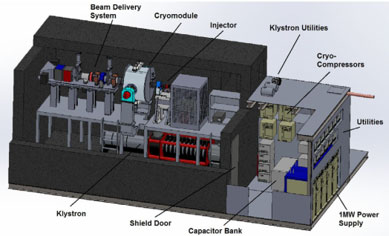
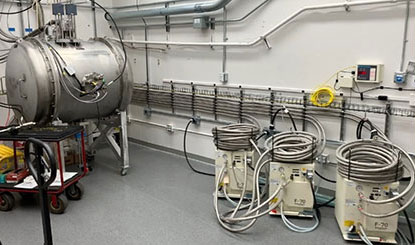
This allows for a conduction-cooled design, where individual cavities are cooled directly by small cryogenic refrigerators, eliminating the need for large-scale helium infrastructure. GA has demonstrated that these systems can match traditional performance while significantly reducing complexity and cost.
SRF technology is highly efficient at transferring RF power to particle beams, with minimal losses in the cavity walls. In many systems, most losses occur in the RF source itself.
Magnetrons offer a powerful solution, converting 70–90% of electrical power into RF energy, which far exceeds the efficiency of traditional sources like klystrons. They are also significantly more cost-effective.
By pairing magnetrons with conduction-cooled SRF technology, GA and Thomas Jefferson National Accelerator Facility are developing systems that combine high efficiency, lower cost, and simplified infrastructure.
The combination of superconducting cavities, efficient magnetron RF sources, and compact cooling systems enables accelerators that are:
These innovations also extend SRF capabilities to high-energy and high-availability applications.
For example, the Spallation Neutron Source at Oak Ridge National Laboratory uses dozens of SRF cavities to produce proton beams at GeV-scale energies—far exceeding typical industrial accelerators. These beams generate neutrons used to study materials and support applications such as advanced nuclear energy systems and nuclear waste treatment.
Emerging technologies such as thin-film superconductors and magnetron-driven systems can significantly reduce the cost and power requirements of next-generation accelerators.
Since the early days of the atomic age, General Atomics has translated advanced technologies into practical solutions through innovation and collaboration.
Today, GA is helping lead the commercialization of superconducting accelerator technology by integrating thin-film superconductors, compact cryogenic systems, and high-efficiency RF power sources.
By reducing cost, size, and complexity, these advancements are transforming particle accelerators from specialized scientific instruments into scalable, precision industrial tools.